Build your brand into the Gen-AI shopping experience. Or miss out.
Authored by Simon Andrew for Saint Clair’s, Germany. Simon is director of strategy, copy and clarity at Saint Clair’s. His professional interests include brand strategy, messaging and storytelling - and how these interface with AI Visibility Strategy, GEO and generative content creation.
Increasingly, online commerce begins inside large language models (LLMs) as people use generative AI (Gen-AI) to identify, research and compare goods and services.
It’s already possible to complete the entire shopping journey “from chat-to-checkout” without being punted to a retailer website. LLMs are on their way to becoming THE online marketplace.
Buyers can discover > compare > choose > pay > get confirmation in LLMs such as ChatGPT, Alibaba Qwen app, Gemini (US only) and MS Copilot (US only), Perplexity (limited items).
The adoption signals are loud and clear
A growing body of data shows that AI-assisted purchasing is no longer a niche behaviour, it’s becoming mainstream:
Shopping-related Gen-AI use grew 35% from Feb 2025 to Nov 2025, and spans everyday categories, not just big-ticket items, (BCG).
Generative-AI traffic to U.S. retail sites went up 1,300% YoY (Nov–Dec 2024), and up 4,700% YoY in July 2025 (Adobe).
39% of consumers - and over half of Gen Z – are currently using AI for product discovery (Salesforce).
Morgan Stanley predicts nearly half of U.S. online shoppers will use AI shopping agents by 2030( Business Insider).
Bottom line. If your brand isn’t built into the GenAI ecosystem, you risk becoming invisible to the next generation of shoppers.
Shoppers like using LLMs for many reasons
The Gen-AI shopping experience is direct, objective, transparent, and personalized. It also helps shoppers figure out what they want even when they are not initially sure.
To break it down a little further:
· It’s direct: no pop-ups, no cookie banners, no sign up
· It’s objective-ish: it compares without pretending every option is “premium”
· It’s transparent: it can explain why it recommends something
· It’s personalized: it asks questions, narrows choices, remembers preferences
· It clarifies: it helps people figure out what they want even when they start with “uh… something nice?”
The combination is attractive to online purchasers. It’s like having a calm friend with you in the store while the rest of the internet is waving inflatable arms and shouting “LIMITED TIME OFFER.”
The two challenges brands must solve to win at Gen-AI shopping
When consumers embark on a shopping journey inside LLMs, brands must achieve the following:
1) Get included
If you don’t appear during the initial discovery and comparison phases of the shopping journey, you won’t be there at purchase. Simple as gravity.
2) Get represented accurately
Showing up isn’t enough. You need your brand reflected correctly in terms of benefits, positioning, tone of voice, proof, policies, and differentiators.
You want to avoid some generic summary that could describe any competitor with a logo swap.
This is where GEO (AI search) and agentic commerce standards matter. In environments using OpenAI’s Agentic Commerce Protocol (ACP) or Google’s Universal Commerce Protocol (UCP), agents can pull structured product data, availability, policies and checkout steps from authoritative sources instead of improvising.
Net: put humans first with genuinely useful content delivered in a brand relevant manner, while still being machine-readable enough for agents to trust it, cite it, and surface it in the buying journey.
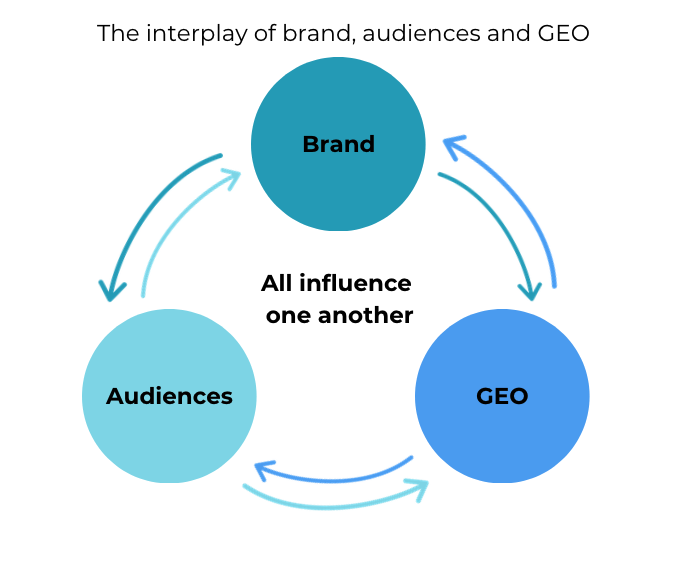
How brand, audiences and GEO influence one another
Brand <> audiences
Your brand defines the promise: what you stand for, how you speak, what you prioritise. That shapes who pays attention, what expectations they bring, and whether they trust you enough to engage, buy, recommend or ignore you politely.
Audiences <> GEO
Audiences leave behavioural fingerprints everywhere: clicks, dwell time, reviews, shares, citations, purchases. GEO systems (LLMs, answer engines, shopping agents) treat this human interaction as evidence. If real people engage, the model infers relevance and credibility. No audience signal, no algorithmic confidence.
GEO <> brand
GEO determines how your brand is reconstructed inside AI systems: what facts are surfaced, which benefits are emphasised, what tone leaks through, and whether you’re framed as “the obvious choice” or “one of many”. Poor structure or weak signals and the AI fills in the blanks… creatively.
The loop effect between brand, audeinces and GEO
· Strong brand > clearer audience engagement
· Strong engagement > stronger GEO signals
· Strong GEO > more accurate brand representation
· Better representation > attracts the right audience
Break one part of the loop and the system wobbles. Getting it right is the difference between getting noticed in the right way or being invisible.
7 steps to becoming an "Agent-Ready" brand
To transition from "agent-invisible" to "agent-ready," brands must treat AI as a primary marketing channel. Here is how to build your brand into the GenAI experience:
1. Treat product data as marketing fuel
LLMs cannot sell what they cannot parse. You must provide content that is properly structured, persuasive and on-brand.
Prioritize: Clean, unique titles, rich technical specs, sizing, materials, and real-time availability.
Conversational commerce: Platforms like Google Merchant Center are already adding attributes specifically for conversational discovery. Ensure your data is "fluffy" enough to be persuasive but structured enough to be accurate.
2. Implement agentic commerce integrations
The plumbing of commerce is changing. If you sell online at scale, start scoping support for ACP (OpenAI/Stripe) for instant checkouts or UCP (Google) as it matures. Even if you don’t enable them today, your technical stack must be capable of "chat-to-checkout" functionality.
3. Win the "LLM Shortlist" with proof
LLMs lean on corroboration. They don't just take your word for it, they look for independent reviews, creator content, and credible comparisons. So do whatever you can to make sure these are available.
Pro Tip: Build FAQ pages that answer real-world buying questions (e.g., "Will this work with X?"). Adobe’s data shows AI-referred visitors have lower bounce rates because the AI has already "pre-qualified" them for you.
4. Prepare for "Interface Tax"
When a checkout happens inside an AI assistant, you risk losing control over the brand experience and the direct customer relationship because there are fewer brand touchpoints
To mitigate “interface tax” focus on the post-purchase experience: have excellent packaging, post-purchase loyalty and support efforts become your primary way to build the relationship.
5. Instrument for "AI-as-a-channel"
You cannot manage what you do not measure. Set up your analytics to specifically track:
Which LLMs (ChatGPT, Perplexity, Gemini) are driving conversions?
Which of your pages are being cited as sources?
Where are users dropping out during the "agent hand-off"?
6. Create "agent-safe" offers
Agents love simple, binary decisions. Help them by offering:
Bundles: "Starter kits" or "Best-value sets."
Guardrails: Clear "don't recommend if..." rules to prevent misrepresentation.
7. Deploy Branded Agents
Where platforms allow, use branded agents that speak in your specific voice. In categories where guidance is critical, such as in skincare, fitness, or B2B software - a branded agent can serve as a 24/7 expert salesperson who ensures your brand isn't misrepresented by a generic model.
A powerful differentiator for 2026 and beyond
This year’s challenge is to build your brand into the LLM experience. By treating your product data as fuel and your agent strategy as a sales flow rather than a chatbot, you will ensure that when an AI "agent" makes a recommendation, your brand is the only logical choice.