Five essentials for brand visibility in the age of automation.
Authored by Simon Andrew for Saint Clair’s, Germany. Simon is director of strategy, copy and clarity at Saint Clair’s. His professional interests include brand strategy, messaging and storytelling - and how these interface with AI Visibility Strategy, GEO and generative content creation.
The AI + Human coordination problem
Your teams write fast, in different styles, in different silos. While your AI tools freestyle and flatten your edge because search engines and answer engines index fragments that don’t add up to a coherent entity. So, you don’t get cited in ChatGPT, Perplexity or Gemini because the models can’t find a stable story, consistent entities or proof.
The uncomfortable truth, most brands are screaming into a void. They treat AI visibility and human connection as separate work streams. They hire a poet for the humans and a technician for the robots. This schizophrenia can create a disjointed reality where your human audience might feel connection, while AI sees an unrecognisable data set. Or worse. The AI hallucinates a version of you that doesn't exist because you failed to feed it the right signals.
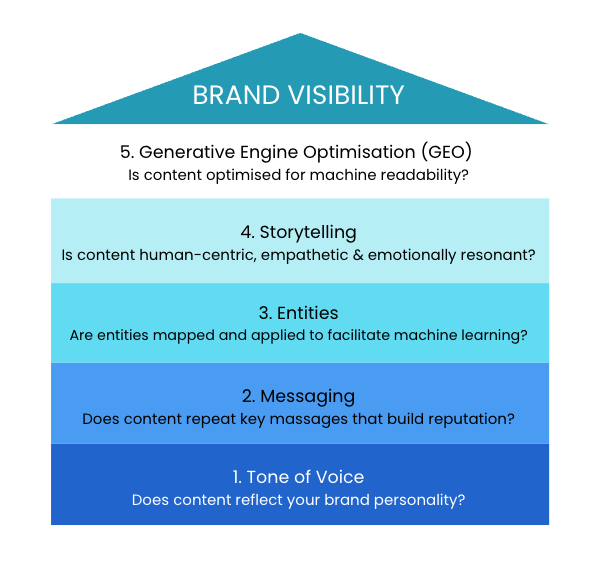
The fix lies in coordination of your tone of voice, messaging, entities, storytelling and GEO (generative engine optimisation / AI search) so they operate like a stage crew moving a single spotlight that clearly illuminates your brand for both humans and LLMs.
Get your brand tone of voice, messaging, entities, storytelling and AI search working together
You want people to feel and connect with your brand. You also want large language models to find it, understand it and cite it. So your content needs to address both audiences, otherwise you risk leaking attention as well as losing the ability to show up in large language models where, increasingly, purchasing journeys begin.
Hint: Generic content that bores humans and bewilders AI is not the way to go.
Tone of voice impacts both AI search and human trust
Your tone of voice (ToV) is not simply for differentiation. It’s a constraint system that makes your brand familiarly identifiable to humans and predictable to AI models. Your ToV teaches people how to feel about your brand and AI how to speak for you.
ToV also impacts how your brand engages LLMs. Because they are prediction engines that look for consistent patterns. So the goal is to be consistently unusual. Because if your tone is generic, you are statistically insignificant. You blend into the training data of a million other mediocre companies. But a strong, codified tone acts like a cryptographic key. It tells the AI, "This content belongs to this brand entity, not the generic soup most other brands are swimming in."
So be sure to document your brand’s unique voice with clearly structured rules, examples and counter-examples – tied to your core entities, e.g.: brand, offers, proof, audiences.
Bake you ToV into prompts and system messages. Build a small “brand tone model” that includes things like preferred verbs, sentence rhythm, humour boundaries and taboo phrases. Machines love boundaries. Humans love personality. Be sure to keep both consistent because consistency builds trust over time, the whole point of branding.
Brand messaging answers: “What do you want to be known for?”
Messaging can be defined as the ideas you repeat until they become reputation. For humans, this can be structured as a message house. For AI, it becomes an entity map: consistent claims attached consistent “entities”. You should, for example, define your primary product claims, supporting proofs, and possible objections with crisp answers that address them. You tag them with the language your buyers actually type, including questions like “How does (your brand name) compare to its competitors?” and “What products does (your brand) integrate with?”. The idea is to keep wording stable across web, sales decks, PR and product UI so that AI retrieval systems see the same claims supported by the same evidence. This is essential if you want LLMs to mention and cite your content without making up some weird alternate universe for your brand.
Entities are messaging for machine learning
Machine learning uses entities to decide what your brand is. Your ToV might be distinctive and your messaging sharp, but if your content doesn’t resolve into stable entities, AI systems treat your brand like a handful of unrelated facts wearing the same logo.
An entity can be anything related to your brand, e.g.: your company name, your flagship offer, a service line, a capability, a category you want to own, a buyer role, a competitor, a partner, or a named methodology. The job is to map and explicitly define your entities so they can be used consistently.
The practical approach is to do it the way machines like it:
Conduct an entity inventory: identify your core entities (brand, offers, audiences, problems, proof, partners, competitors).
Create an “Entity truth sheet” of, e.: canonical names, aliases, definitions, differentiators, proof points, and the best URL for each.
Define entity relationships, e.g.: brand > offers > for audience > solves problem > using method > proven by case studies/results.
Put differently: humans remember stories. Machines remember IDs. Entities are your brand’s ID system.
Storytelling trains models and moves buyers
Stories are memory glue. For people, they collapse complexity into scenes and stakes and make the customer the hero, using methodology explained here. For AI, they create patterns models can recognize and reproduce. Stories bind information together in a way that is hard to break, even for a machine. You might think storytelling is too soft for the hard logic of a neural network. You’d be wrong. AI models prioritise relevance and engagement. And human engagement is an indicator of value. When you weave a narrative, humans stay on the page. They share. They cite. This creates a web of social proof that the AI recognises and rewards.
So be sure to treat every case study, founder note and customer quote as dual-use: persuasive for humans and structured training for AI engines. Write narrative with clear roles, timelines, metrics and outcomes so it parses cleanly. Turn each story into an answer format as well: a short Q&A, with a “How it works,” and “What changed” paragraphs. When someone searches “How to turn case studies into AI training data,” the answer is this: tell the same story in multiple different, well-structured formats so models can latch onto it.
What is Generative Engine Optimisation (GEO) and why it matters here
GEO makes your brand findable, understandable and citable by generative systems such as LLMs. How do you achieve this? You publish content that answers real questions directly. You mark up your key entities with schema (e.g.: organisation, people, services, FAQs) so systems don’t have to guess what’s what. You maintain canonical URLs for every major idea. You cluster related answers so models see topical authority rather than isolated posts. You include sources, data points and quotable lines that invite citation. You optimize for queries like “best (category) for (use case)”, “alternatives to (competitor)”, “is (your brand) good for (industry)?”, and “how does (your product) work?” If you’re comparing “GEO vs SEO,” think of GEO as SEO with an attitude: still technical, but built for dialog engines that compose answers, not just rank links.
How tone of voice, messaging, entities, storytelling and GEO work together
These five elements are not a menu. They must work in concert to gain attention in the age of automation.
Tone of voice (ToV) gets you recognised. Your ToV is an expression of your brand’s unique personality and it makes outputs recognisably yours in terms of style, tone and manner, building a memorable signature through repetition across all touchpoints.
Messaging defines your brand’s distinctive reality - by repeating ideas until they become reputation. Created in your tone of voice, your messaging decides what claims, offers and pitches you consistently repeat, so both humans and LLMs know what your brand is about.
Entities make your brand legible to machines - again they can be seen as “consent messaging for machines.” They give AI a stable “who/what” to attach to your ToV, claims and proof so your brand and the facts related to it show up in a predictable manner.
Storytelling frames messaging into scenes and desirable outcomes people remember and quote – and that AI recognises and cites when stories are properly structured. The best stories allow the prospective customer to identify as the hero, e.g., a case study written as a story about how your brand not only helped someone save their business from ruin, but helped them grow and thrive.
GEO connects ToV, messaging, entities, and storytelling into a system of discovery - so AI can retrieve, evaluate and cite facts about your brand. In practice, you write a message once in your tone, you express it as a story with proof, then you publish it in a GEO-ready package with clear questions, structured answers and schema. This way, people feel your brand and AI crawlers find distinctive evidence of it, so that you earn mentions in feeds and citations in answers in a way you want your brand to be represented.
The above are the five pillars of brand visibility in the age of automation. Don’t venture out into the new AI universe without applying them.